Brewery Water Filtration: Complete Guide for Beer Production
Why Water Quality Is Critical in Brewing
Beer is 90-95% water. That single fact makes water the most important raw ingredient in any brewery — more important than the malt, hops or yeast. Water chemistry directly affects mash efficiency, hop extraction, fermentation behavior, mouthfeel and flavor. Brewers in Pilsen, Dublin and Burton-on-Trent built world-famous beer styles partly because of their local water profiles. In modern brewing, you do not need to be lucky with your source water — you need a proper filtration and treatment system to control it.
Consistency is the real challenge. Source water changes seasonally: rainfall, river levels, and municipal treatment changes all shift mineral content, chlorine levels and turbidity. If your filtration does not smooth out these variations, your beer will taste different from batch to batch — and customers notice.
What Are the Key Water Problems for Breweries?
Different breweries face different source water problems, but the most common issues are:
- Sediment and turbidity — suspended particles, sand and rust from pipelines that cloud the water and foul downstream equipment.
- Chlorine and chloramine — municipal disinfection chemicals that create medicinal off-flavors (chlorophenols) in beer, even at very low levels.
- Hardness — high calcium and magnesium scale up heat exchangers and boilers, and can throw off mash chemistry.
- Organic compounds and algae — taste and odor problems, especially from surface water sources.
- Microbial contamination — bacteria and yeast spoilage organisms that ruin fermentation.
- High mineral variability — inconsistent water chemistry that makes recipe control difficult.
What Filtration Stages Does a Brewery Need?
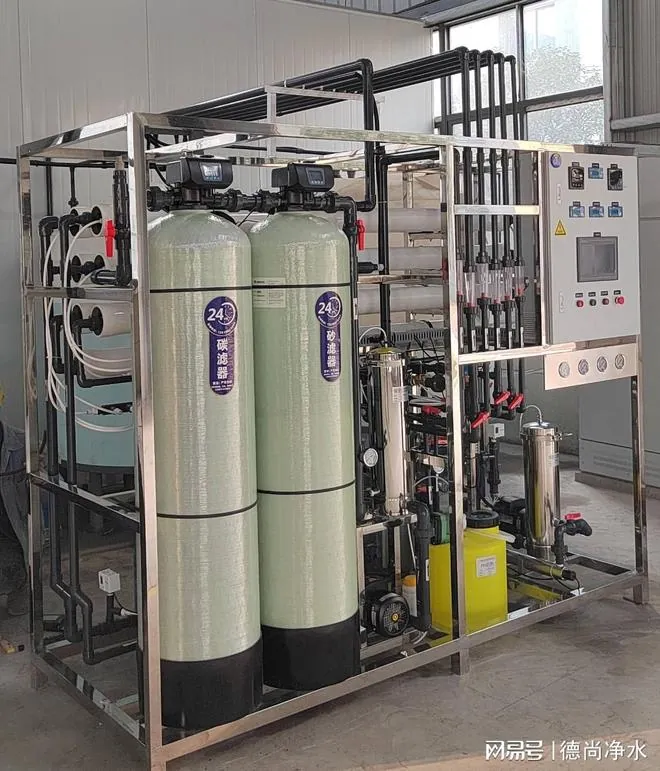
A well-designed brewery water system is multi-stage. Each stage removes a different class of problem:
Stage 1 — Sediment pre-filtration: PP melt blown cartridges (5-20 micron) remove sand, rust and suspended solids. This protects everything downstream and is the most cost-effective first step.
Stage 2 — Activated carbon filtration: Carbon block or GAC cartridges remove chlorine, chloramine, organics, and improve taste and odor. This is the stage that eliminates the dreaded "chlorine off-flavor" in beer.
Stage 3 — Softening or RO: For hard water, a softener exchanges calcium and magnesium for sodium. For full control, reverse osmosis strips virtually all minerals, giving brewers a blank canvas to rebuild the exact water profile their recipes need.
Stage 4 — Final polishing: A 1-micron or sub-micron filter before the brew house removes any remaining particulates and biological material.
Optional — UV disinfection: For breweries using surface water or with microbial concerns, UV treatment provides chemical-free disinfection.
How Do You Design a Brewery Water System?
The right system depends on three things: your source water quality, your production volume, and your beer styles. A brewery making 500 liters per batch with good municipal water may only need sediment + carbon filtration. A 50,000-liter facility with hard well water will almost certainly need softening or RO, plus a higher flow rate across every stage.
The correct first step is always a water analysis. Test for turbidity, chlorine, hardness, TDS, iron, manganese, and microbial counts. With that data, a filtration supplier can size the system correctly — undersizing causes pressure drops and short cartridge life, oversizing wastes money.
What Standards Apply to Brewery Water?
Brewing water must meet drinking water standards in the country of production. In the European Union, water contact materials and treatment systems are subject to food contact regulations, and certification expectations are rising for export-focused breweries. For breweries selling into regulated markets, choosing filtration components with recognized certifications (CE, NSF or local food-grade approvals) simplifies compliance and audit readiness.
How Often Should Brewery Filter Cartridges Be Replaced?
Replacement intervals depend on feed water quality and production volume, but typical guidelines are:
- PP sediment cartridges: every 3-6 months, or when pressure differential rises
- Carbon block cartridges: every 6-12 months
- RO membranes: every 2-4 years with good pretreatment
Monitoring pressure gauges and flow meters tells you exactly when a cartridge has reached capacity. Many breweries replace cartridges on a calendar schedule tied to their quality audits, which is simple and traceable.
Conclusion: What Water Filtration Does Your Brewery Need?
Every brewery, from craft nano-breweries to industrial producers, needs at least sediment and carbon filtration to make consistent, clean beer. As you grow, adding softening or RO gives you complete recipe control, and UV or final polishing protects quality. The investment in water treatment is small compared to the cost of a ruined batch — and it pays for itself in consistency, fewer rejects, and the ability to brew the full range of beer styles.