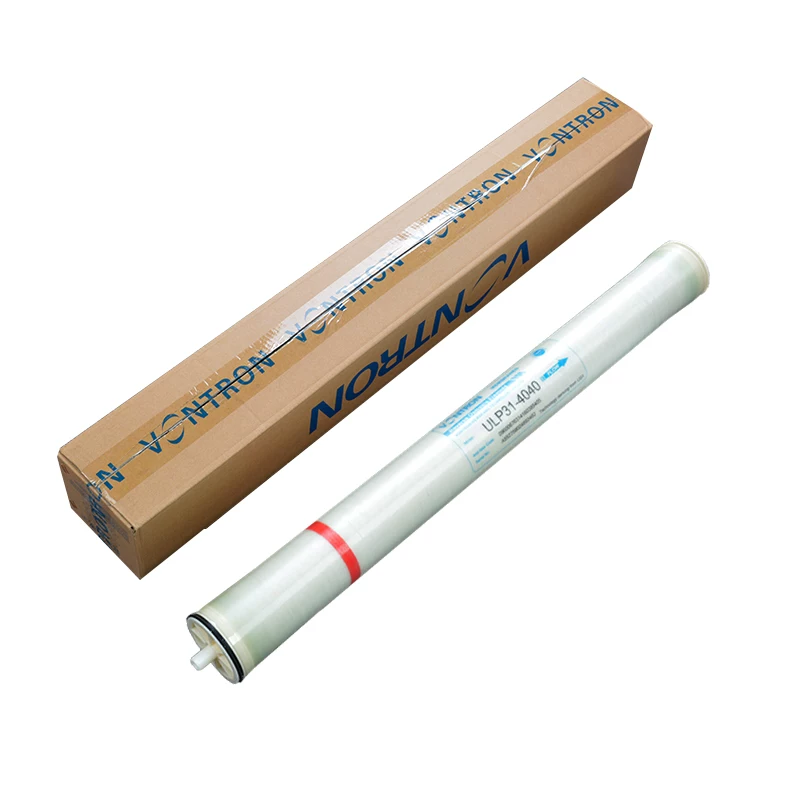
If you are buying RO membranes for a water treatment system, the first question is always: 4040 or 8040?
The short answer: 4040 is for smaller commercial systems, 8040 is for larger industrial systems. But the right choice depends on your flow requirements, space, and budget.
Quick Comparison Table
| Specification | RO 4040 (4") | RO 8040 (8") |
|---|---|---|
| Dimensions | 4" × 40" | 8" × 40" |
| Permeate flow* | 1,800-2,600 GPD (0.28-0.41 m³/h) | 9,000-12,000 GPD (1.4-1.9 m³/h) ✅ |
| Salt Rejection | 99.5% | 99.5% |
| Operating Pressure | 150-250 psi | 150-300 psi |
| Membrane Area | ~80 ft² | ~365 ft² ✅ |
| Price Range | $80 - $150 ✅ | $300 - $600 |
| Best For | Commercial RO, drinking water | Industrial, desalination ✅ |
1. Size and Dimensions
The names tell you the size: 4040 is 4 inches in diameter and 40 inches long, while 8040 is 8 inches in diameter and 40 inches long. Both fit standard pressure vessels of the same diameter.
The 8040 has about 4.5 times more membrane surface area than the 4040, which is why it can produce much more water.
2. Flow Rate and Capacity
This is the biggest practical difference. At standard test conditions (2,000 ppm NaCl, 225 psi, 25 °C, 15% recovery) a single 4040 brackish-water element produces roughly 1,800-2,600 gallons per day (0.28-0.41 m³/h). An 8040 produces 9,000-12,000 gallons per day (1.4-1.9 m³/h) — about 4.5 times more, which is exactly what you would expect from 4.5 times the membrane area.
Quoted figures vary between datasheets because they are quoted at different test pressures and temperatures. Higher feed temperature and higher pressure both raise output; higher feed salinity lowers it. Always compare two elements at the same test conditions, or the numbers mean nothing.
For a small bottled water plant doing 1,000 GPD, one 4040 is enough. For a municipal plant treating 100,000 GPD, you need an array of 8040s in series and parallel.
3. Price Comparison
| Quantity | RO 4040 | RO 8040 |
|---|---|---|
| 1-10 pcs | $80 - $150 ea | $300 - $600 ea |
| 10-50 pcs | $65 - $120 ea | $250 - $500 ea |
| 50+ pcs | $50 - $100 ea | $200 - $450 ea |
4. Applications
RO 4040 is best for:
- Bottled water plants (small to medium)
- Drinking water kiosks
- Commercial RO systems
- Small-scale brackish water treatment
- Lab and pharmaceutical (small volume)
RO 8040 is best for:
- Municipal water treatment plants
- Industrial process water
- Seawater desalination
- Large-scale bottled water production
- Wastewater recycling systems
How These Elements Are Written (and Searched)
The 4040 and the 8040 are both 40 inches long — only the diameter differs. That is why the two are so often confused in search and in quotations, and why they turn up in half a dozen written forms:
| Written as | Where you see it |
|---|---|
| 4040 / 8040 | The standard industry shorthand, and how we list them |
| 4" x 40" / 8" x 40" | Specification sheets and datasheets |
| 4x40 / 8x40 | Handwritten notes and search terms |
| 80 40 / 80-40 | A frequent typo for 8" x 40" — the quotation mark is dropped |
| RO 40 | Shorthand for the 40-inch element length |
If you are searching for an 80 40 membrane, an 8x40, a 4x40 membrane or an RO 40 element, you are looking at one of these two products. The 4040 is the 4-inch diameter element at 200–300 GPD; the 8040 is the 8-inch diameter element at 1.0–1.5 m³/h. If your system was built for 8-inch pressure vessels, the 4040 will not fit — and vice versa.
5. Which One Should You Buy?
Choose 4040 if: Your system needs under 5,000 GPD. You have limited space. You want a lower upfront cost.
Choose 8040 if: Your system needs over 5,000 GPD. You want lowest cost per gallon. You have space for larger pressure vessels.
Rule of thumb: If you are starting a small bottled water business, go with 4040. If you are setting up an industrial treatment plant, go with 8040.
Need Help Sizing Your RO System?
Tell us your daily water demand and feed water quality. We will recommend the right membrane configuration.
📦 Free samples available — just pay shipping
Request a Quote →Full Technical Specifications
Both elements are thin-film composite (TFC) polyamide membranes on a polyester support. The figures below are typical for brackish-water elements — your exact datasheet may differ slightly.
| Specification | RO 4040 (4") | RO 8040 (8") |
|---|---|---|
| Element diameter × length | 4" × 40" (99 × 1,016 mm) | 8" × 40" (201 × 1,016 mm) |
| Active membrane area | ~80–85 ft² (7.4–7.9 m²) | ~365–400 ft² (34–37 m²) |
| Membrane chemistry | TFC polyamide composite | TFC polyamide composite |
| Permeate flow* | 1,800–2,600 GPD (0.28–0.41 m³/h) | 9,000–12,000 GPD (1.4–1.9 m³/h) |
| Nominal salt rejection* | 99.5% | 99.5% |
| Test pressure | 225 psi (1.55 MPa) | 225 psi (1.55 MPa) |
| Max operating pressure | 600 psi (4.1 MPa) | 600 psi (4.1 MPa) |
| Max feed temperature | 45 °C (113 °F) | 45 °C (113 °F) |
| pH range (continuous / cleaning) | 2–11 / 1–13 | 2–11 / 1–13 |
| Free chlorine tolerance | < 0.1 ppm | < 0.1 ppm |
| Typical recovery (single element) | 15% | 15% |
| Pressure vessel | 4" — 1–3 elements per vessel | 8" — up to 6–7 per vessel |
* Quoted at standard test conditions: 2,000 ppm NaCl, 225 psi (1.55 MPa), 25 °C, 15% recovery, pH 7. Real output depends on feed temperature, salinity and pressure. Two elements can only be compared at the same test conditions — check the datasheet for the exact element before you design the system.
How Many Elements Do You Need?
Work backwards from the permeate flow the plant actually needs. These are single-pass brackish-water figures at 25 °C:
| Target permeate | Right choice | Elements | Configuration |
|---|---|---|---|
| up to 2,000 GPD (7.6 m³/day) | 4040 | 1 | single 4" vessel |
| 2,000–6,000 GPD (7.6–23 m³/day) | 4040 | 2–3 | 4" vessels in parallel |
| 6,000–10,000 GPD (23–38 m³/day) | 8040 | 1 | single 8" vessel |
| 10,000–40,000 GPD (38–150 m³/day) | 8040 | 2–4 | 8" vessels in parallel |
| 40,000–100,000 GPD (150–380 m³/day) | 8040 | 6–10 | 8" array, 2 stages |
| 100,000+ GPD (380+ m³/day) | 8040 | 10+ | multi-stage array |
Two rules of thumb worth remembering: above roughly 6,000 GPD the 8040 wins on cost per cubic metre, and below 6,000 GPD the 8040 is usually overkill — you pay for capacity you cannot use, and you need a bigger feed pump to keep an 8" element inside its cross-flow range.
Cost per m³, Not Cost per Element
Both element sizes are listed on our product pages: RO membrane 4040 and RO membrane 8040.
An 8040 looks expensive next to an $80–150 4040. Per cubic metre of water it is the cheaper element, because it produces about 4.5 times as much from the same footprint at the same pressure.
| Aspect | RO 4040 | RO 8040 |
|---|---|---|
| Typical element price | $115 | $450 |
| Permeate (mid-range) | 0.35 m³/h | 1.65 m³/h |
| Water per element life (8,000 h/yr, 3 years) | ~8,400 m³ | ~39,600 m³ |
| Element cost per m³ | ~$0.014 | ~$0.011 |
That is roughly 20% cheaper per cubic metre on the element alone — before the knock-on savings of fewer vessels, fewer housings, less piping and less labour per change-out. At large capacity the gap widens, because you are maintaining one 8" skid instead of three or four 4" skids.
Assumptions: element cost only, 8,000 operating hours per year, 3-year element life, mid-range prices. Energy, pretreatment and labour are excluded — they matter, but they scale the same way at both diameters.
When the 8040 Is the Wrong Choice
Bigger is not automatically better. Choose the 4040 when:
- Your demand is under about 6,000 GPD. A single 8040 already makes more than you can use, and you cannot turn an element down — you either cycle the plant or run below design recovery.
- You have one small vessel and no room for an 8" skid. 4" vessels fit into existing plant rooms and standard cabinets.
- You want cheap redundancy. Two 4040s in parallel give you a spare without stopping production; splitting an 8" array does not.
- You are feeding a bottling line, a drinking-water kiosk or a laboratory. That is 4040 territory.
- Your feed pump cannot deliver the cross-flow an 8" element needs. An 8040 needs a much higher feed rate to hold recovery in range — that means a bigger pump and bigger pretreatment, not just a bigger element.
Vessel and Housing Compatibility
Diameter is the hard constraint. A 4040 fits a 4" (102 mm) pressure vessel; an 8040 fits an 8" (203 mm) vessel. They are not interchangeable:
- 4040 in a 4" vessel — 1 to 3 elements per vessel, standard for commercial systems.
- 8040 in an 8" vessel — up to 6–7 elements in one vessel, which is how industrial trains are built.
- 4040 in an 8" vessel — possible with an adapter, but the brine seal does not seat properly and feed leaks past the membrane instead of through it. Do not do it.
- 8040 in a 4" vessel — impossible, it will not physically fit.
If the whole system is still being designed rather than re-elemented, the array layout matters as much as the element size — see industrial RO system design.
Check the vessel nameplate before ordering. If you are replacing elements in an existing plant, we can match from a photo of the vessel end or of the old element label — see send us your membrane for matching.
FAQ
What is the difference between a 4040 and an 8040 RO membrane?
Only the diameter. Both are 40 inches long, thin-film composite polyamide elements. The 4040 is 4 inches in diameter with about 80–85 ft² of membrane area and produces roughly 1,800–2,600 GPD; the 8040 is 8 inches in diameter with about 365–400 ft² and produces roughly 9,000–12,000 GPD. Because the length and chemistry are the same, the 8040 is essentially four 4040s in one housing.
How many gallons per day does a 4040 membrane produce?
Typically 1,800–2,600 GPD (0.28–0.41 m³/h) for a brackish-water element at 225 psi, 25 °C and 2,000 ppm feed. Low-pressure and high-rejection variants sit at the low end; high-productivity variants at the top. Warm feed water raises output by roughly 3% per °C.
How many GPD does an 8040 membrane produce?
Typically 9,000–12,000 GPD (1.4–1.9 m³/h) under the same test conditions. That is about 4.5 times a 4040, matching its 4.5 times greater membrane area.
Can I replace a 4040 with an 8040?
Not directly. The 8040 will not fit a 4-inch pressure vessel. Upgrading to 8040s means new 8-inch vessels, a higher-flow feed pump, revised piping and usually larger pretreatment. Treat it as a plant upgrade, not an element swap.
What pressure do 4040 and 8040 membranes need?
Both are rated to 600 psi (4.1 MPa) maximum operating pressure and are normally run at 150–300 psi for brackish water. Seawater grades run at 800–1,200 psi. Running below the design pressure lowers output and rejection; running above it damages the element and voids the warranty.
Which is cheaper per litre of water?
The 8040, once you are above roughly 6,000 GPD. Element cost per cubic metre works out near $0.011 for the 8040 against $0.014 for the 4040, and the gap widens when you count fewer vessels, less piping and less labour per change-out.
Can I use 4040 and 8040 in the same system?
Technically yes, but it is not recommended. They need different pressure vessels and flow configurations, and mixed trains make balancing recovery and cross-flow unnecessarily difficult. Stick to one diameter per system.
How long do RO membranes last?
Two to three years with proper pretreatment. Feed water quality is the dominant factor: chlorine attack, iron, scaling and excessive silt density index all shorten life. A well-designed pretreatment stage is what actually protects the membrane.
Do you offer custom RO membrane configurations?
Yes. We supply brackish-water, seawater and wastewater elements, and we can match an existing element from a photo of its label or the vessel end. Tell us your permeate target and feed water analysis and we will recommend the element count, array and vessels.