10, 20, 30 or 40 Inch Filter Cartridges: How Size Changes Everything
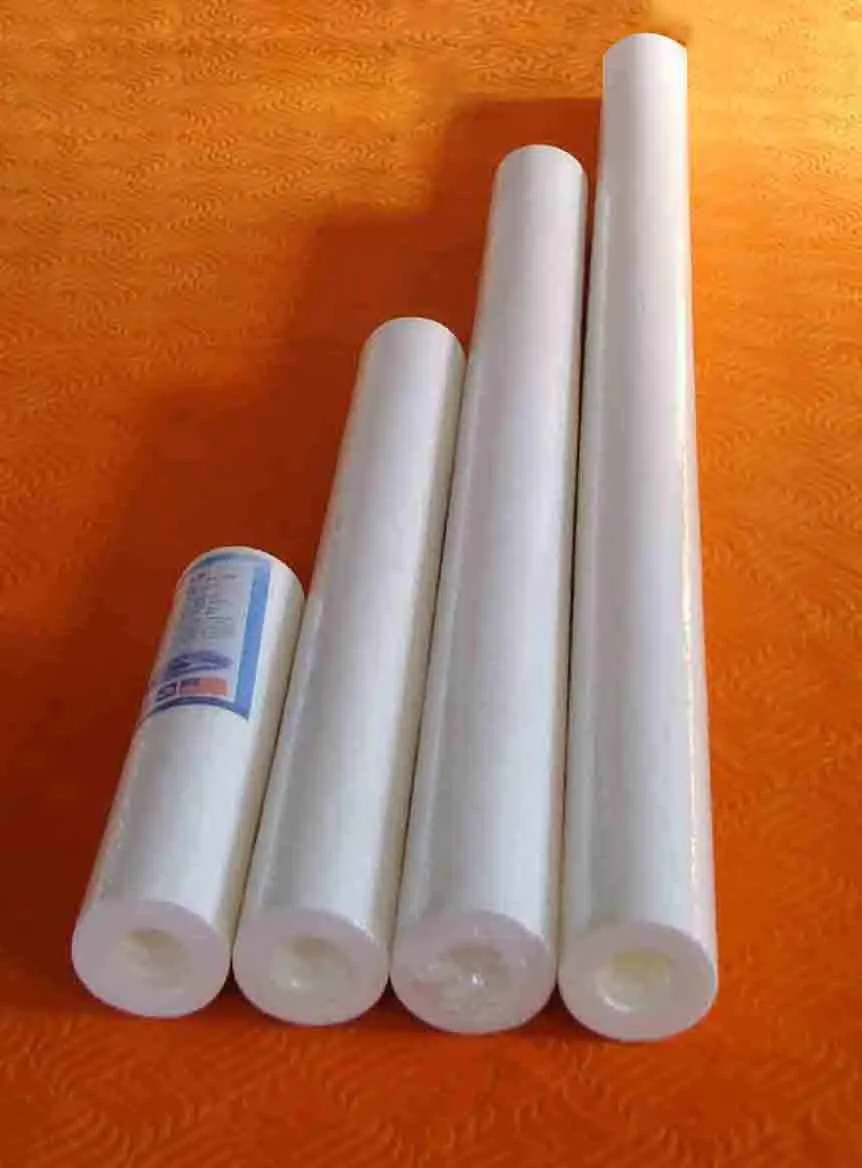
Buyers spend hours comparing micron ratings and almost no time on physical size. Then the cartridges arrive, and they are 20 inch elements going into a 10 inch housing. Size is not a packaging detail — it sets your flow rate, your change interval, and your cost per cubic metre.
Here is what actually differs between the standard lengths, and how to size a stack from your pump instead of guessing.
Length buys surface area, not filtration quality
A 40 inch PP element does not filter any better than a 10 inch one at the same micron rating. It simply has roughly four times the surface area, so it holds about four times the dirt before it blinds. Same water quality out, very different change interval and pressure drop.
That is the whole trade: longer elements cost more per piece and need taller housings, but cost less per cubic metre treated and need fewer changes. For a plant running continuously, the 40 inch element usually wins on labour alone.
The four standard lengths
| Nominal length | Actual length (approx.) | Typical housing | Where it belongs |
|---|---|---|---|
| 10 inch | 250 mm | Single or 3-round slimline | Point of use, small packers, lab and dosing lines |
| 20 inch | 508 mm | Single or multi-round | The mainstream industrial size — whole-plant feed, RO pretreatment |
| 30 inch | 762 mm | Tall single housing | Mid-size lines where 20 inch changes too often |
| 40 inch | 1016 mm | Tall single housing, often 4.5 inch diameter | High-flow lines, fewest changes per year |
Diameter matters as much as length
Two elements can both be 20 inch and behave completely differently, because the standard diameters are 2.5 inch (63 mm) and 4.5 inch (114 mm). The 4.5 inch element has roughly three times the surface area of the 2.5 inch one at the same length.
In practice: 20 inch by 2.5 inch is the classic slimline — cheap, everywhere, fine up to about 1 m³/h. 20 inch by 4.5 inch, often called a big blue, is the industrial workhorse: 2–3 m³/h per element and far more dirt capacity. If you are deciding between adding a second 2.5 inch housing or moving to a single 4.5 inch housing, the 4.5 inch is usually the cheaper answer over a year.
Flow per element
Working figures at typical water temperatures. Push well past these and the element collapses its own dirt capacity — you get high pressure drop and particle breakthrough long before the element looks dirty.
| Element | Practical flow | Notes |
|---|---|---|
| 10″ x 2.5″ | 0.3–0.5 m³/h | Household-scale only |
| 20″ x 2.5″ | 0.8–1.2 m³/h | Small plant, dosing water |
| 30″ x 2.5″ | 1.2–1.8 m³/h | Middle ground |
| 20″ x 4.5″ | 2–3 m³/h | Most common industrial choice |
| 40″ x 4.5″ | 4–6 m³/h | High flow, fewer changes |
Connection type decides compatibility
- DOE (double open end): flat gaskets at both ends, the low-cost standard for PP and carbon block.
- 222 / 226 with fin: a bayonet-style insert at one end, standard on RO membrane elements because it keeps feed and permeate separate.
- Threaded: less common, used where the element must not be fitted the wrong way round.
A 222 element will not fit a DOE housing, and no adapter makes it safe to force. Confirm the connection type on the existing housing before ordering a replacement batch — this is the single most common wrong order we see.
Sizing a stack from your pump
Take your feed pump flow, add a margin, divide by the practical flow per element. Example: a 3 m³/h feed line.
- One 20″ x 4.5″ element: at its limit, changes often.
- Two 20″ x 4.5″ in parallel: 1.5 m³/h each, comfortable, roughly double the interval.
- One 40″ x 4.5″: also comfortable, one housing instead of two — cheaper plumbing, taller footprint.
Then stage it: a 20 micron element ahead of a 5 micron element costs one extra cartridge and typically extends the fine element's life by several times. Coarse to fine always beats a single fine element.
Cost per cubic metre, not cost per piece
Factory-direct PP melt blown cartridges run roughly $0.50–3 per piece depending on size and micron, carbon block roughly $2–8, and pleated or specialty media above that. Those numbers mean nothing without the change interval. A $1 cartridge changed every two weeks is more expensive than a $2.50 cartridge changed every six.
Track two things on site: pressure drop across the housing, and cartridges used per month. Once you have both, the choice between 20 inch and 40 inch stops being a guess.
Frequently asked questions
Can I use a 20 inch cartridge in a 10 inch housing?
No. The housing is sized to the element, and the closing mechanism will not seal. Replacing elements is a like-for-like job unless you also change the housing.
Does a longer cartridge filter finer?
No. Length changes surface area and dirt capacity. The micron rating is set by the media, not the length.
How many cartridges do I need for a 5 m³/h line?
With 20 inch by 4.5 inch elements at 2–3 m³/h each, two in parallel gives a comfortable margin. One 40 inch by 4.5 inch element also covers it if you prefer a single housing.
Is a bigger housing always better?
Not always. Bigger housings cost more upfront and need more vertical space, and a plant that runs two hours a day will not recover that cost through longer intervals. Above roughly six hours a day, the maths flips in favour of the larger element.
Do cartridge sizes differ between manufacturers?
The nominal sizes are industry standard, so a 20 inch by 4.5 inch element fits a 20 inch big blue housing from any major maker. Check the actual length in millimetres and the connection type before a bulk order.
Tell Us Your Flow Rate
Send your pump flow and housing type, and we will come back with element size and quantity.
PP Melt Blown Cartridges — 1–100 micron, 10″–40″
Carbon Block Cartridges
Filter Housings
Related: micron rating selection guide