Borehole Water Filtration: Which Filter Cartridges You Actually Need
Most filtration advice you will find online was written for municipal water. Borehole water is a different problem altogether. It can come up completely clear and still carry 3 mg/L of dissolved iron that will stain everything downstream, or look like milk and then settle overnight in the tank. If you pick cartridges based on what the water looks like in a bucket, you will either blind a 5-micron element in ten days or pay to remove particles that were never there.
This guide is written for plants and packers running on their own borehole — common across West and East Africa, the Gulf, and inland Algeria — where nobody upstream is treating the water for you.
Test first, buy second
You cannot size a cartridge stack from a photo of the water. You need six numbers, and any water lab or agricultural extension office can produce them for a small fee. If there is no lab nearby, a portable TDS/EC pen plus an iron test kit covers most of it.
| Test | Reading | What it decides |
|---|---|---|
| Turbidity (NTU) | Under 5 = clear 5–50 = silty Over 50 = muddy | Over 50, cartridges alone are the wrong tool — you need settling or coagulation first, or you will change elements weekly |
| Iron (mg/L) | Under 0.3 = fine Over 1.0 = problem | Dissolved iron passes straight through every cartridge. It has to be oxidised and settled before filtration |
| Manganese (mg/L) | Over 0.1 | Black staining, same behaviour as iron |
| Hardness (mg/L as CaCO₃) | Over 300 = hard | Cartridges do not soften. Hard water scales RO membranes — softener goes before the RO |
| TDS (ppm) | Under 500 = fine 500–1000 = borderline Over 1000 = RO | This is the single number that tells you whether you need reverse osmosis at all |
| Bacteria (CFU/100 mL) | Any growth | No cartridge sterilises water. Disinfect before the carbon stage, not after |
What a cartridge actually removes — and what it does not
This is where most buyers get burned, so let us be blunt about it.
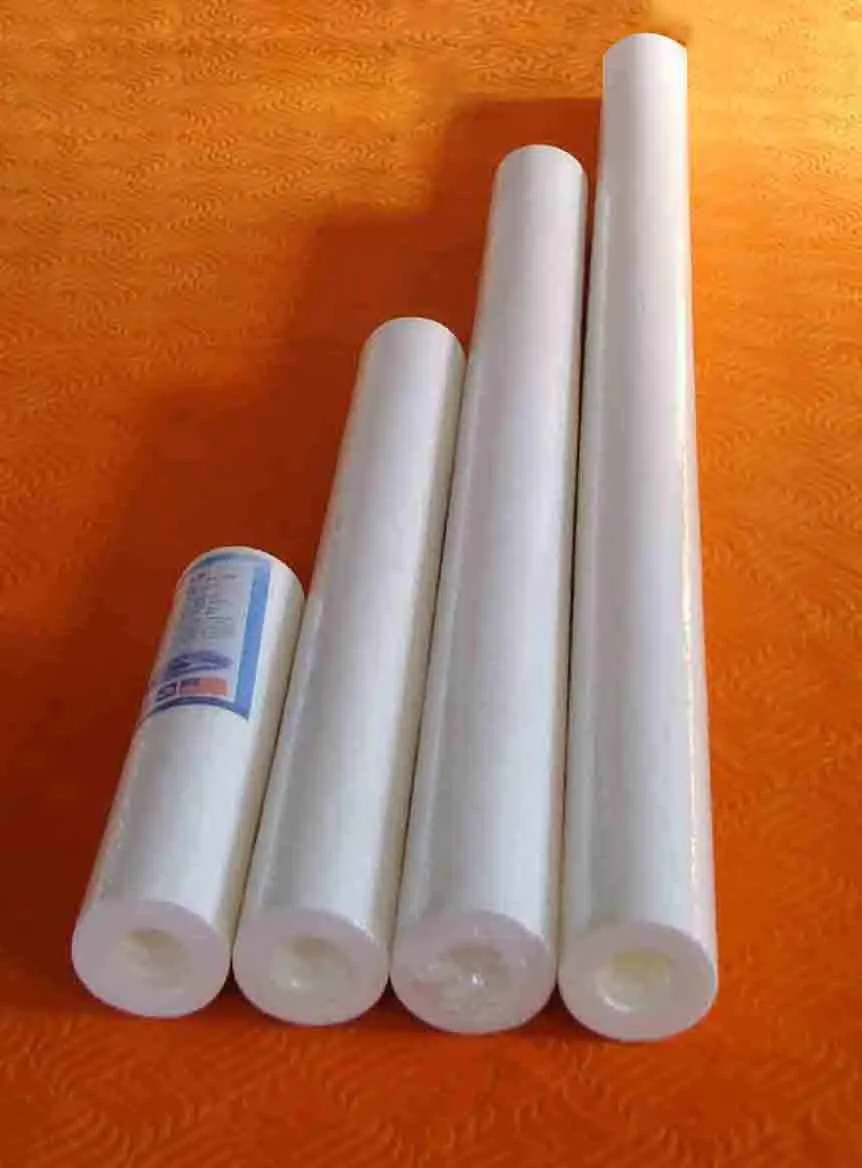
- PP melt blown (1–100 micron) removes particles: sand, silt, rust flakes, scale fragments. It removes nothing dissolved.
- Carbon block (5 micron typical, finer grades available) removes chlorine, taste, odour, colour and some organics. It does not remove nitrate, fluoride, or salt.
- RO membranes remove dissolved salts, nitrate, fluoride and most heavy metals. They are the only element in the stack that touches TDS.
- No cartridge removes dissolved iron, hardness, or bacteria. If your water has those problems, the cartridge stack sits behind a treatment step that handles them — it does not replace it.
Three borehole profiles and the stack that fits each
Profile A — sandy or silty water, low TDS, no iron
Typical of river-adjacent boreholes and flood plains. Water is clear most of the year and goes cloudy after rain.
Stack: 20″ PP at 20 micron → 20″ PP at 5 micron → carbon block if chlorine or taste matters. Two-stage coarse-to-fine beats one fine element, because the coarse one takes the load and the fine one polishes. A single 5-micron element in this profile is a money leak.
Profile B — iron-bearing water (red-brown stains)
Water runs clear from the tap and stains the tank, the toilet, or your product lines. If iron is above 1 mg/L, a cartridge alone will blind fast and you will blame the cartridge.
Stack: aeration or chlorine oxidation → retention or settling tank → 20″ PP at 20 micron → 5 micron → carbon block. The oxidation step turns dissolved iron into particles; only then can a cartridge catch it.
Profile C — high TDS, brackish or arid-inland water
Common in the Gulf, inland Algeria and parts of the Horn of Africa. Water tastes salty; TDS often runs 1500–4000 ppm.
Stack: PP at 5 micron → carbon block → RO (4040 elements for small skids, 8040 for larger). Pretreatment is not optional here — a fouled membrane costs far more than a handful of cartridges. If hardness is above 300 mg/L, put a softener ahead of the RO.
Sizing the stack to your pump
Cartridge count is set by flow, not by tank size. These are working figures for standard housings at typical borehole temperatures:
| Element size | Typical flow per element | Where it fits |
|---|---|---|
| 10″ x 2.5″ | 0.3–0.5 m³/h | Small packers, point-of-use, not a whole-plant feed line |
| 20″ x 2.5″ | 0.8–1.2 m³/h | Small plants, dosing and wash water |
| 20″ x 4.5″ | 2–3 m³/h | The workhorse for a mid-size plant |
| 40″ x 4.5″ | 4–6 m³/h | High-flow lines, fewer element changes |
| RO 4040 | 0.2–0.3 m³/h permeate | Small RO skids |
| RO 8040 | 1.0–1.5 m³/h permeate | Larger RO systems |
If your pump delivers 3 m³/h, one 20″ x 4.5″ element is already at its limit. Two in parallel halves the flux per element, which roughly doubles the time between changes. That trade is almost always worth it.
Signs you waited too long to change
Do not change on a calendar. Change on pressure drop: when the differential across a housing climbs by about 1 bar (15 psi) over its clean baseline, the element is done. Downstream of that, you will also see reduced flow and, eventually, particle breakthrough — which is worse than a slow line because it puts dirt into your product.
Frequently asked questions
Do I need RO for borehole water?
Only if TDS is genuinely high. Under 500 ppm and no specific contaminant problem, a PP and carbon stack is enough for most process uses. Above 1000 ppm, RO is the realistic answer.
How many microns should the first stage be?
Two stages beat one. Start at 20 micron to catch the bulk, then 5 micron to polish. A single 1-micron element as a first stage is a fast way to spend money on cartridges.
Can a carbon block remove iron?
No. It can hold some oxidised iron particles that reach it, but it does not remove dissolved iron from water.
Will a cartridge make borehole water safe to drink?
Not by itself. Sediment and carbon improve taste and clarity; microbiological safety needs disinfection and, where relevant, testing. Treat filtration and sterilisation as two separate jobs.
What changes between wet and dry season?
Turbidity, mostly, and sometimes iron as the water table moves. Expect to run a coarser first stage in the wet season and to shorten intervals accordingly.
Send Us Your Water Report
Tell us turbidity, iron, hardness and TDS, and we will come back with a cartridge stack and quantities — no charge.
PP Melt Blown Cartridges (1–100 micron)
Carbon Block Cartridges
RO Membrane 8040 — 1.0–1.5 m³/h
Contact us for sizing help